

Decontamination Kits
Our decontamination kits are built to tackle the stubborn stuff, the fallout, tar, bonded contaminants and invisible grime that washing alone just can't shift. Each one pairs a chemical decon step with the clay and lubricant to follow it, so you're not working out what goes with what. From CARPRO, MIRCH and Waxit, for everything from a maintained car through to years of neglect.
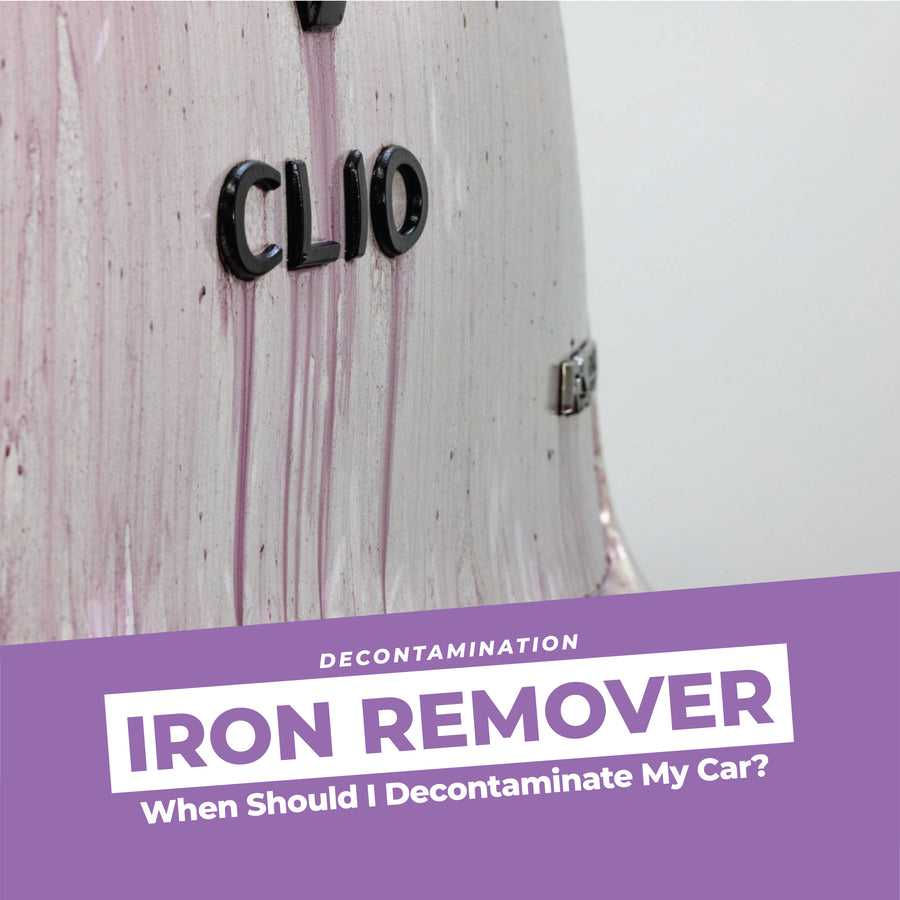
 GuideVehicle Decontamination & Iron RemoversRead the guide ›
Featured items & kits
Hand picked for this category


In action
Decontamination Kits, in action


Decontamination Kits
FAQ's: Decontamination Kits
How to tell if your car needs decontaminating, what the process involves, what a good kit should include, and the difference between chemical and mechanical decon. These are the questions we get asked the most.
Still unsure? Ask us ›How do I know if my car needs to be decontaminated?
A decontamination process is usually performed right before paint correction or the application of a protective coating such as a ceramic coating, wax or spray sealant. It's virtually impossible to achieve a quality paint correction without first removing the contaminants bonded to your paint, and leaving them there greatly affects the bonding and durability of whatever protection you apply.
The simplest test is your hand. Wash the car, then run your fingertips over the paint inside a thin plastic bag. If it feels gritty or rough rather than glass smooth, there's bonded contamination sitting there.
Ideally you should only need to decontaminate every three to six months if the vehicle is used daily and kept outside in harsh conditions, or as little as once every few years for a garaged car with limited use.
If your car is already coated, stick to chemical decontamination to maintain the coating's performance and longevity. Mechanical decontamination with a clay bar can be done over a coating, but it risks marring the surface and taking the top layer off, so an iron remover or a decontamination wash is the safer periodic maintenance.
For more, read our guide on vehicle decontamination and iron removers, or get in touch.
The simplest test is your hand. Wash the car, then run your fingertips over the paint inside a thin plastic bag. If it feels gritty or rough rather than glass smooth, there's bonded contamination sitting there.
Ideally you should only need to decontaminate every three to six months if the vehicle is used daily and kept outside in harsh conditions, or as little as once every few years for a garaged car with limited use.
If your car is already coated, stick to chemical decontamination to maintain the coating's performance and longevity. Mechanical decontamination with a clay bar can be done over a coating, but it risks marring the surface and taking the top layer off, so an iron remover or a decontamination wash is the safer periodic maintenance.
For more, read our guide on vehicle decontamination and iron removers, or get in touch.
What does it mean to decontaminate a car?
Put simply, decontaminating a car involves removing stubborn contaminants that can't be removed with a regular maintenance wash. These include iron fallout, brake dust, tar, bugs, dirt, grime and more.
The process usually begins with a thorough wash to remove any surface level contaminants, followed by the application of an iron remover such as CARPRO IronX LimeScale or Nv PURIFY to begin breaking down what's left, then a rinse.
Once that's done, a clay bar treatment is used alongside a lubricant to lift and remove any remaining contaminants the wash and the iron remover didn't shift. After rinsing and drying, the surface is inspected and any marring, which is often a result of using a clay bar, gets polished out by hand or with a machine.
A tar remover is worth adding to that sequence if the lower panels have picked up road tar, since an iron remover won't touch it.
The process usually begins with a thorough wash to remove any surface level contaminants, followed by the application of an iron remover such as CARPRO IronX LimeScale or Nv PURIFY to begin breaking down what's left, then a rinse.
Once that's done, a clay bar treatment is used alongside a lubricant to lift and remove any remaining contaminants the wash and the iron remover didn't shift. After rinsing and drying, the surface is inspected and any marring, which is often a result of using a clay bar, gets polished out by hand or with a machine.
A tar remover is worth adding to that sequence if the lower panels have picked up road tar, since an iron remover won't touch it.
What should I be looking for in a Decontamination Kit?
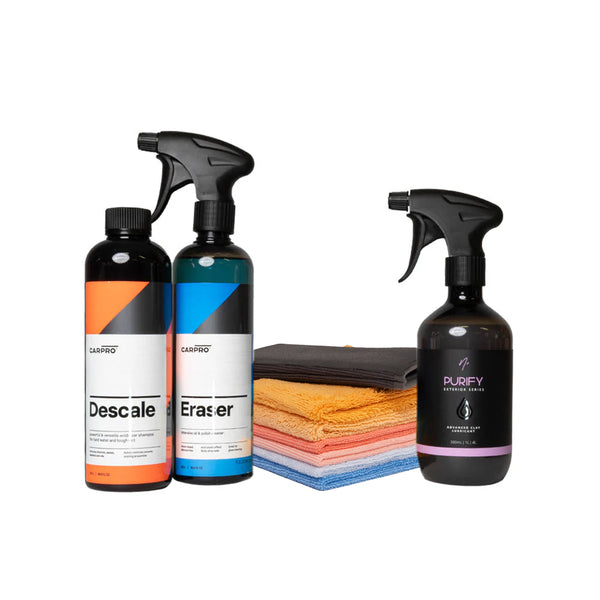
There are a few staples that make the job as effective as possible. Any good decontamination kit should include an iron remover to break down fallout, a clay bar or mitt to physically remove what's left, and a clay lubricant to make that step safe.
In some cases, like Nv PURIFY, one product does two jobs. It's both an iron remover and a lubricant, so while it's lubricating the clay bar it's also breaking down contamination on the paint.
The bigger kits go further and add a prep spray to strip oils and residue at the end, plus microfibre cloths for the wipe downs. That's what separates a basic clay kit from a full decontamination setup.
Check what's listed on each kit's page rather than assuming, since the difference is usually how many stages it covers rather than product quality.
In some cases, like Nv PURIFY, one product does two jobs. It's both an iron remover and a lubricant, so while it's lubricating the clay bar it's also breaking down contamination on the paint.
The bigger kits go further and add a prep spray to strip oils and residue at the end, plus microfibre cloths for the wipe downs. That's what separates a basic clay kit from a full decontamination setup.
Check what's listed on each kit's page rather than assuming, since the difference is usually how many stages it covers rather than product quality.
What is the difference between a Chemical and Mechanical decontamination?
Decontamination typically involves two main types, chemical and mechanical.
Chemical decontamination uses detailing chemicals on the paint and is performed first. These include iron removers, tar and adhesive removers, all purpose cleaners, water spot removers and degreasers.
Mechanical decontamination comes after, and it's the process of using an automotive clay bar and lubricant to physically remove the more stubborn contaminants the chemical phase couldn't shift.
Keep in mind that claying will leave slight marks on the paint, known as marring. That's very normal and a very light polish will remove it easily.
Be aware that a clay bar should not be used on matte or satin paint, or on textured plastics and plastics with matte or satin finishes.
Chemical decontamination uses detailing chemicals on the paint and is performed first. These include iron removers, tar and adhesive removers, all purpose cleaners, water spot removers and degreasers.
Mechanical decontamination comes after, and it's the process of using an automotive clay bar and lubricant to physically remove the more stubborn contaminants the chemical phase couldn't shift.
Keep in mind that claying will leave slight marks on the paint, known as marring. That's very normal and a very light polish will remove it easily.
Be aware that a clay bar should not be used on matte or satin paint, or on textured plastics and plastics with matte or satin finishes.